The Quiet Room Has a Waiting List: UK Libraries Are Hiring Out Podcast Booths
Photo: Harris & Ewing, Public domain, via Wikimedia Commons
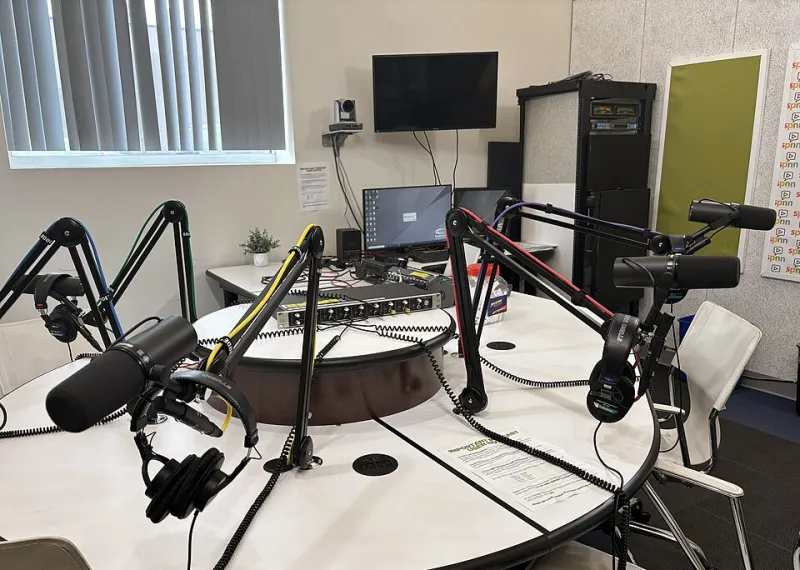
Walk into a city library on a wet Tuesday and you expect the usual: returns queue, photocopier, someone whispering into a mobile phone by the noticeboard. What you might not expect is a small room with a boom arm, a dynamic mic and a waiting list. Across the UK, library services and community centres are turning spare meeting rooms, digital hubs and former study carrels into bookable podcast booths. Some are free. Some cost less than a round of coffees. Almost all of them are booked out by people who would never have afforded a commercial studio.
This is not a glossy revolution. It is patchy, underfunded and often staffed by someone who has read the manual more recently than you have. But it is happening, and for a certain kind of UK creator — the one recording in a shared flat, a noisy house or a kitchen with a boiler doing backing vocals — it is quietly useful.
Why the library, of all places?
The appeal is not mysterious. Commercial studio time in the UK can run from £40 to well over £100 an hour, before you have paid for an engineer. For a hobbyist making a six-episode series about local history, that maths does not work. A library booth at free-to-£10 an hour does.
There is also the trust factor. Libraries are public, accessible and usually close to transport. They have opening hours that stretch beyond the working day, staff who are used to helping people use unfamiliar equipment, and a remit that includes digital skills rather than just books. A community centre might have a quieter room, but the library has the photocopier, the Wi-Fi and the institutional habit of lending people things they cannot afford to buy.
And let’s be honest: libraries already own the one thing podcasters need most. Quiet. Or at least, a recognisable version of it.
What is actually in the booth?
This is the first question to ask, because “podcast booth” can mean anything from a treated room with a Rodecaster Pro and four microphones to a study room with a table, a chair and a optimistic sign on the door.
A typical setup in the newer library spaces includes a dynamic microphone on a boom arm, a small audio interface, closed-back headphones, a desktop stand or shock mount, and some acoustic foam on the worst walls. Some services provide an SD card or a recorder; many expect you to bring your own. A few have a laptop with recording software already open. Others have nothing but the room and a plug socket, which is still more than many people have at home.
The lesson is simple: never assume. Ask for a full kit list when you book. Ask whether the mic is USB or XLR, whether headphones are included, whether you need to bring an adapter, and whether there is a member of staff who can show you how the interface works. If the answer is “we’ll dig out the box”, budget twenty minutes for setup and bring a backup recorder on your phone.
The boxy-room problem
Small library rooms are not studios. They are often rectangular, with parallel walls, a hard floor and a ceiling that reflects sound straight back at the microphone. That produces flutter echo — the fast, metallic slap you hear when you clap your hands. It makes voices sound thin and distant, and it is the enemy of the warm, close sound most speech podcasts want.
The instinct is to cover every surface in foam or blankets. Resist it. A completely dead room sounds airless and strange, and you will spend hours in post trying to add life back in. The better approach is to control the worst reflections and let the rest be.
Start with microphone technique. Use a dynamic mic if one is available, get close — roughly a fist’s distance — and speak slightly across the capsule rather than straight into it. Proximity gives you warmth and bass without relying on the room. Move away from the exact centre of the room if you can; standing or sitting slightly off-axis reduces the symmetrical bounce between walls. Put a rug down if there is one. Hang a coat or a thick blanket behind the person speaking, not in front of them. A cushion behind the mic stand can help more than a full wall of foam.
When you record, capture thirty seconds of room tone with everyone silent. You will need it later. In editing, a gentle high-pass filter around 80–100 Hz will remove rumble from traffic and ventilation. Do not over-dead-en the voice with noise reduction; a little room is fine. Warmth comes from performance, proximity and a decent level, not from a plugin called “Studio Warmth” that you found on a forum.
The catch: quiet is not soundproof
Libraries are quiet in the way that a library is always quiet: mostly, until someone drops a returns trolley. A bookable booth may sit near the children’s section, the lift, the hand dryer in the toilets or a staff room with a kettle that whistles like a boiling argument. Ask when the building is at its quietest. First thing in the morning is usually better than after school. Avoid half-term if you can. Book the longest slot you can realistically use, but do not assume you will get silence for all of it.
If noise bleeds in, work with it. Record anyway. Note the timecode of the worst interruptions and re-record those lines at the end. A little traffic rumble is easier to fix than a dropped sentence.
A first-timer’s checklist
Before you book, ask:
- What exactly is provided? Mic, interface, headphones, cables, SD card, laptop?
- Do I need to bring my own headphones and storage?
- Is there a staff member who can help me set up?
- How long is the slot, and does it include setup and pack-down time?
- When is the building quietest?
- Is the room treated, or just quiet?
- What file format does the recorder use, and can I take the files away immediately?
- Is there a cancellation policy, and is there a cost?
When you arrive, do a two-minute test: speak at your normal level, clap once, listen back on headphones. If it sounds like a bathroom, move the mic, add a coat behind you and get closer. Save the test file. Then record.
Are libraries becoming podcast infrastructure?
Maybe. The phrase sounds grand for a room with a foam tile and a borrowed mic stand, but infrastructure is exactly what this is: shared, public, repeatable and cheaper than the alternative. It gives people a first rung on the ladder without asking them to build a studio in a spare bedroom they do not have.
The risk is that it stays ad hoc. Booths need maintenance, staff training and replacement cables. A room with a broken interface is not infrastructure; it is a cupboard with a sign. But where library services have invested properly, the results are genuinely useful. Not a replacement for a professional studio, and not trying to be. Just a quiet room, a decent mic and a chance to make something.
If your local library has one, book it. Bring a friend, bring headphones, bring a backup recorder. Record twenty minutes. Listen back. You might be surprised how little you need — and how much a shush can be worth.